
Table of Contents
The Foundation: OSB Decking and Reinforced Substrate
True roofing experts never build on a shaky foundation. We began this project by ensuring the roof deck was composed of high-quality, properly spaced OSB (Oriented Strand Board). This provides the structural “grip” necessary for fasteners to hold firm against high winds.
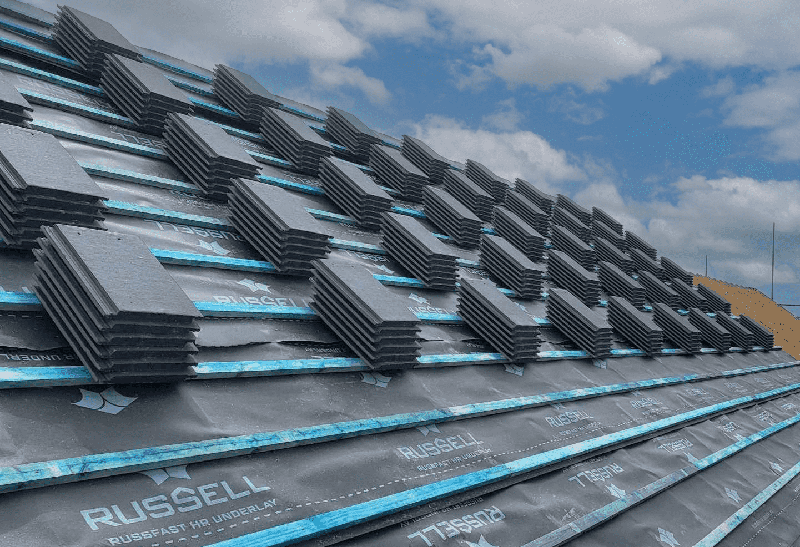
The Secondary Shield: Synthetic Underlayment
Instead of old-fashioned felt paper, we utilize GuardMax Synthetic Underlayment.
Tear Resistance: Unlike felt, this synthetic layer won’t rip or degrade if exposed during the install.
Moisture Barrier: It provides a critical secondary layer of protection that keeps the wood deck dry even if a shingle is damaged.
Precision Application: GAF Timberline HDZ Architecture
We chose GAF Timberline HDZ shingles for this home. These aren’t just for looks; they feature GAF’s “LayerLock” technology. Our team ensures every nail is driven into the “StrikeZone”—the industry’s widest nailing area—guaranteeing 99.9% nail placement accuracy for a wind warranty that actually means something.
The Finishing Touch: High-Profile Ridge Caps
A common amateur mistake is using standard shingles to cover the peak. As seen in our final photos, we use dedicated Ridge Cap shingles. These are thicker, pre-bent, and specifically designed to handle the high-stress wind loads at the roof’s highest point while providing a beautiful, “high-profile” finish.